

Explore our publications by our team of experts within the DDP network. Our publications advance knowledge and contribute to deep decarbonization from the perspectives of our in-country experts.
DDP-Initiative
|
One-pager
2026
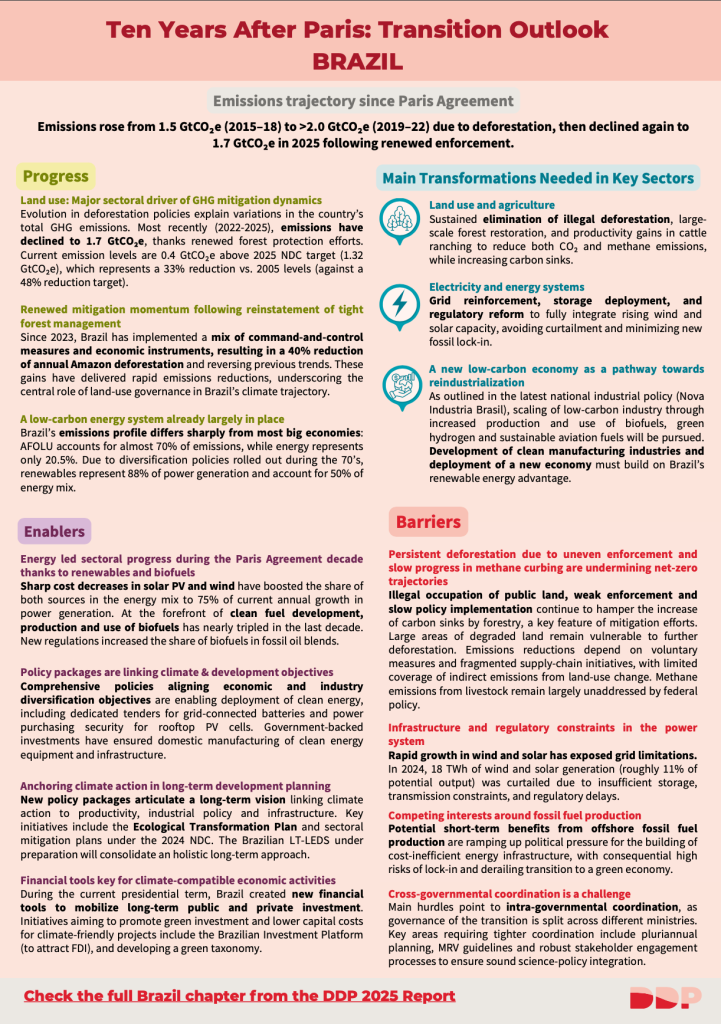
The DDP country one-pagers are a snapshot of full chapters from the 2025 report "A Decade of National Climate Action: Stocktake And The Road Ahead" This Brazil's national pathways are shaping the transition to net zero
Download
DDP-Initiative
|
Article
2024
This paper analyses the role that AFOLU (agriculture, forest and other land use) plays in national deep decarbonization scenarios in Brazil, India and Indonesia between 2020 and 2050. It finds that the LULUCF (land use, land use change and forestry) subsector is important for medium-term mitigation (2020–2030) while continuing to contribute to mitigation over the long-term (2030–2050) in the three countries. Mitigation actions in LULUCF include drastically reducing deforestation (Brazil, Indonesia) and peat degradation (Indonesia), re-/afforestation (all), increased sequestration in standing forests (Brazil, Indonesia) and increasing soil carbon in agricultural lands (India).
Go to publication
DDP-Initiative
|
Report
2023
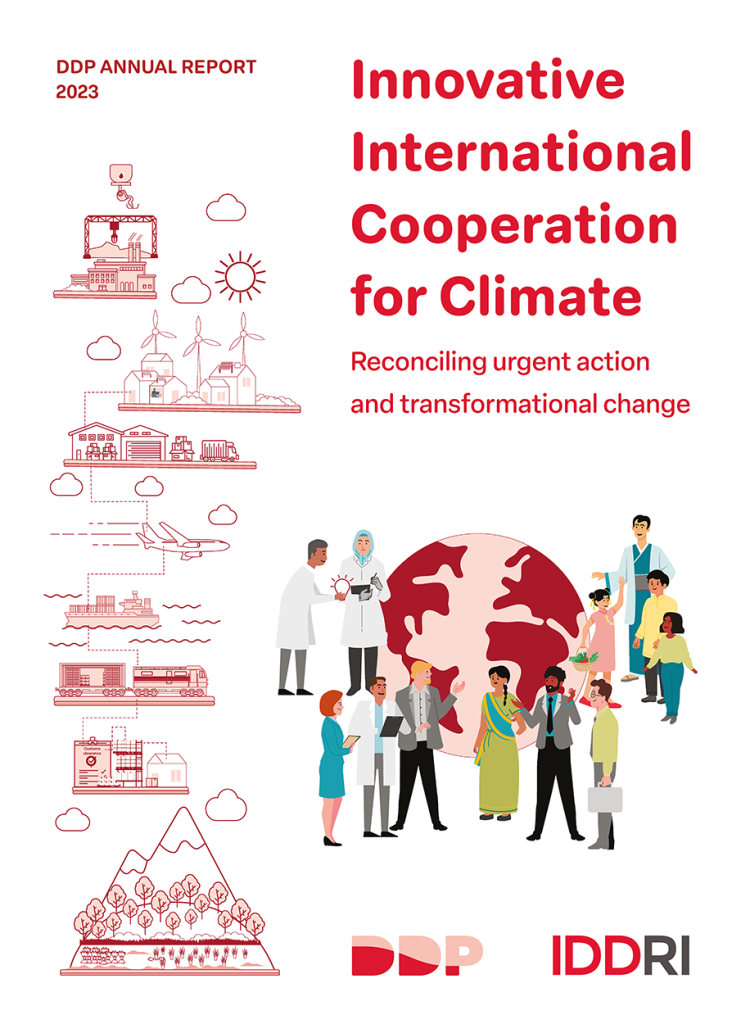
The report emphasizes the urgent need for swift and transformative action on climate change in line with the Paris Agreement’s temperature goals. Incremental changes won’t suffice; instead, a systemic transformation involving both technological and organizational shifts across all sectors and countries is essential. Download the report: Full report Chapters Iron & Steel Freight Transport AFOLU
Go to annual report 2023
DDP-initiative
|
Report
2022
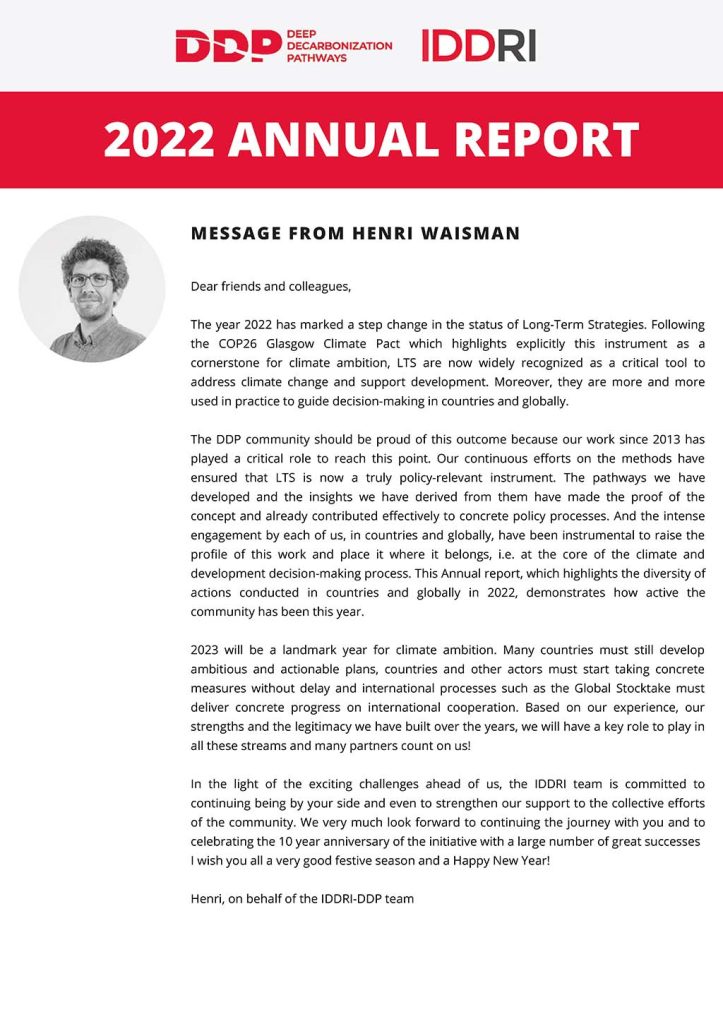
This report summarizes the activities, publications, and other engagements of the DDP in 2022.
Download file
DDP-ACT
|
Note
2022
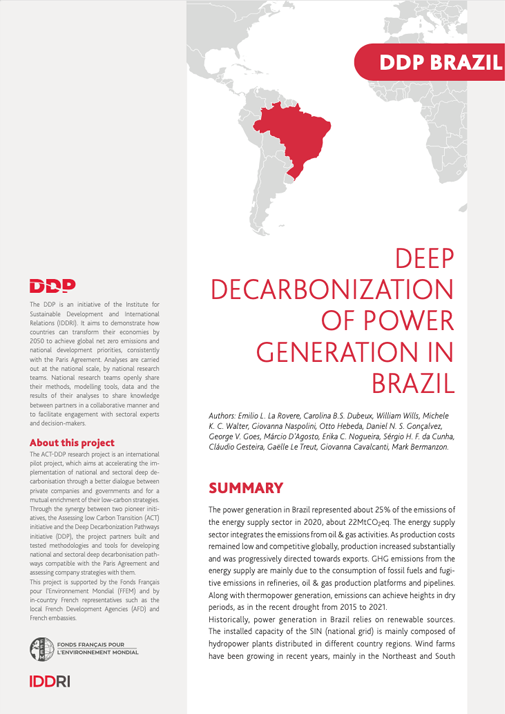
These notes present the main system transformations required to reach a decarbonization pathway, as well as how this differs from current trends and Brazil's climate stated commitments.
Sectors
Economy Wide
Power Generation
Cement
AFOLU
Download
DDP-BIICS
|
Note
2021
Estimating net job creation in long-term decarbonization scenarios for brazil through employment factors.
Download
DDP-BIICS
|
Report
2021
This report presents the main policy lessons emerging from the national Deep Decarbonization Scenarios developed in Brazil. It includes a description of scenario's main features, main synergies and trade-offs with country non-climate objectives, priority short-term policies and actions and key international enablers and accelerators of domestic transitions.
Download
DDP-BIICS
|
Report
2021
This report seeks to open the box of emission pathways, by considering the multidimensional feasibility conditions-i.e. the technical, economic, political, social and institutional- that will enable the required far-reaching and systemic transformation towards the long-term goal.
Download full report
Country chapters
Argentina, Australia, Brazil, Canada, Slovak Republic, Chile, China, Costa Rica, Europe, France, UK, Hungary, Indonesia, India, Italy, Japan, South Korea, Mexico, Nigeria, Peru, Poland, Russia, Senegal, United Kingdom, USA, South Africa, Spain
Sector chapters
Land Use Sector, Industrial Sector, Transport Sector
Download
DDP-BIICS
|
Factsheet
2021
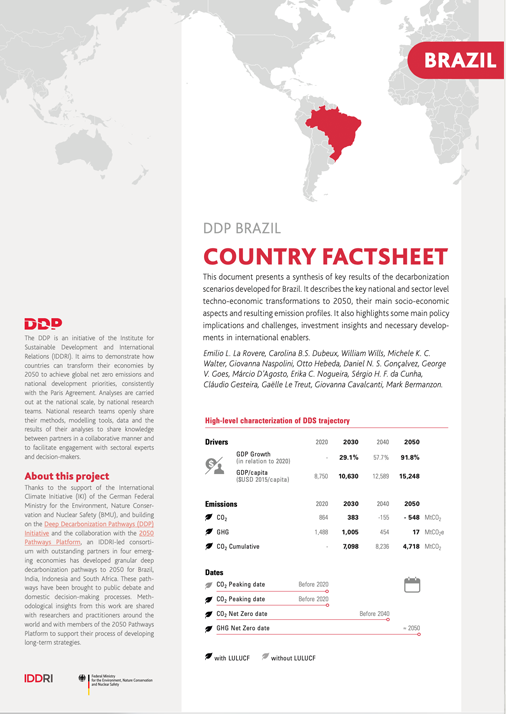
This document presents a synthesis of key results of the decarbonization scenarios developed for Brazil. It describes the key national and sector level techno-economic transformations to 2050, their main socio-economic aspects and resulting emission profiles. It also highlights some main policy implications and challenges, investment insights and necessary developments in international enablers.
Download
DDP-Project
|
Synthesis
2015

The DDPP issued a report on the first phase of its work, preliminary findings on technically feasible pathways, at the UN Climate Summit in September 2014, at the invitation of Secretary General Ban Ki-moon. This report summarized each country team's initial research. In the fall of 2015, all 16 teams published stand-alone reports describing in greater detail their research into national DDPs. This 2015 Synthesis Report provides a cross-cutting analysis of the aggregate results, complementing the executive summary published in September 2015.
Download
DDP-Project
|
Report
2015
This supplementary material contains case studies presenting specific aspects of the DDPP country pathways. They illustrate and complement the cross-cutting analysis included in the 2015 DDPP synthesis report.
Download
DDP-Project
|
Summary
2015
The Deep Decarbonization Pathways Project (DDPP) is a collaborative global research initiative to understand how individual countries can transition to a low-carbon economy consistent with the internationally agreed goal of limiting anthropogenic warming to less than 2 degrees Celsius (°C). Staying within this limit requires global net emissions of greenhouse gases (GHG) to approach zero in the second half of this century. This will entail, more than any other factor, a profound transformation of energy systems, through steep declines in carbon intensity across all sectors, a transition we call "deep decarbonization". EN | FR
Download
DDP-Project
|
Report
2015

Brazil faces the challenge of building upon its historically low energy-related GHG emission levels through new decarbonization strategies, while pursuing higher living standards for its population.
Download
DDP-Initiative
|
Report
2014
The Deep Decarbonization Pathways Project (DDPP)'s 2014 Report, coordinated by IDDRI and SDSN, was published on September 19, 2014. The report has been presented at the United Nations Climate Summit on September 23, 2014.
Download