
Publications
Explore our publications by our team of experts within the DDP network. Our publications advance knowledge and contribute to deep decarbonization from the perspectives of our in-country experts.
- DDP-Mobility
- Brief
- 2017
- Cross country
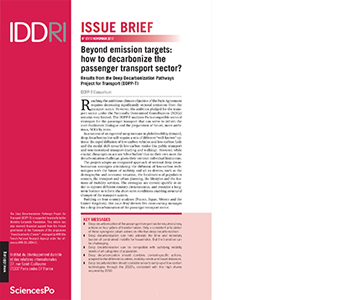
DDP Transport – IDDRI Brief
The Deep Decarbonization Pathways for Transport (DDP-T) project analyzes Paris-compatible sectoral strategies for the passenger transport that can serve to inform the 2018 Facilitative Dialogue and the preparation of future, more ambitious, NDCs by 2020. The project adopts an integrated approach of sectoral deep decarbonization strategies articulating the diffusion of low-carbon technologies with the future of mobility and all its drivers. Building on four country analyses (France, Japan, Mexico and the United Kingdom), this Issue Brief derives five cross-cutting messages for a deep decarbonization of the passenger transport sector.
- DDP-Transport consortium
- DDP-Mobility
- Report
- 2017
- Japan
DDP Transport – Japan
The passenger transport sector accounted for 12% of Japan’s CO2 emissions in 2010. Two Deep Decarbonization Pathways are structured to investigate the way in which different technical and social transformations can reduce the transport-related energy use and GHG emissions. An advanced technological (AdvancedTech) scenario focuses mainly on the technological innovations and transformations in the transport and energy sector, but does not give consideration to social and behavioural factors. On the other hand, the balanced scenario is structured with the objective of developing a long-term strategy to achieve a drastic GHG emission reduction in transport sector by means of a balanced behavioural and technological changes.
- Mikiko Kainuma (NIES/IGES), Toshihiko Masui (NIES), Ken Oshiro (MHIR), Runsen Zhang (NIES)
- DDP-Mobility
- Report
- 2017

- UK, United Kingdom
DDP Transport – United Kingdom
A key challenge for transport policy in the UK is the Government’s own domestic climate legislation, which mandates “at least” an 80% reduction in greenhouse gas (GHG) emissions relative to 1990 levels by 2050. Past analysis reveals that achieving this target translates into a requirement for the carbon intensity of transport to decline by around 70% on average by 2050. We describe two new scenarios that provide distinctive visions of how passenger transport could evolve in the future, driven by rapid technological progress, changes to societal mobility trends, and the requirement to transition towards low or net-zero energy systems. Both of the scenarios presented achieve similar levels of decarbonisation by 2050, but take very different pathways towards that destination.
- Steve Pye, Francis G.N. Li (UCL)
- DDP-Mobility
- Report
- 2017
- France, Mexico
DDP Transport – France
The transport sector is the main emitting sector and represented about 26% of total French GHG emissions in 2010. The French DDP team chose to develop two scenarios for the passenger transport sector consistent with the 2°C target and the SNBC objectives, reaching both a reduction of about 78% of CO2 emissions compared to 1990, down to about 20 MtCO2 in 2050. These two deep decarbonization pathways embody contrasting futures of the mobility demand, as well as the supply-side solutions that will be necessary.
- Yann Briand (IDDRI)Julien Lefevre (CIRED)Jean-Michel Cayla (EDF R&D)
- DDP-Mobility
- Report
- 2017
- Mexico
DDP Transport – Mexico
The transport sector is the single largest source of GHG emissions in Mexico with a fourth of the total. Two scenarios are presented, both leading to a 50% reduction in annual CO2 emissions of the passenger transport sector by 2050 (50 MtCO2) compared to the level in 2010.
- Jordi Tovilla (Tempus Analitica) Daniel Buira (Tempus Analitica)
- Other
- Technical paper
- 2015

- Cross country
DDPP – Handbook
This technical paper presents guidance on how to conduct 2050 pathways analyses. It suggests criteria, principles and building blocks for a successful development of pathways, as well as selected illustrations. It is intended to be read together with: Why Develop 2050 Pathways?
- Henri Waisman (IDDRI)Jim Williams (SDSN)
- DDP-Project
- Synthesis
- 2015
- Australia, Brazil, Canada, China, France, Germany, India, Indonesia, Italy, Japan, Mexico, Russia, South Africa, South Korea, UK, United Kingdom, USA
DDPP – 16 countries – Synthesis
The DDPP issued a report on the first phase of its work, preliminary findings on technically feasible pathways, at the UN Climate Summit in September 2014, at the invitation of Secretary General Ban Ki-moon. This report summarized each country team’s initial research. In the fall of 2015, all 16 teams published stand-alone reports describing in greater detail their research into national DDPs. This 2015 Synthesis Report provides a cross-cutting analysis of the aggregate results, complementing the executive summary published in September 2015.
- DDPP Consortium
- DDP-Project
- Report
- 2015
- Australia, Brazil, Canada, China, France, Germany, India, Indonesia, Italy, Japan, Mexico, Russia, South Africa, South Korea, UK, United Kingdom, USA
DDPP – 16 countries – Supplementary Material
This supplementary material contains case studies presenting specific aspects of the DDPP country pathways. They illustrate and complement the cross-cutting analysis included in the 2015 DDPP synthesis report.
- DDPP Consortium
- DDP-Project
- Summary
- 2015
- Australia, Brazil, Canada, China, France, Germany, India, Indonesia, Italy, Japan, Mexico, Russia, South Africa, South Korea, UK, United Kingdom, USA
DDPP – 16 countries – Executive Summary
The Deep Decarbonization Pathways Project (DDPP) is a collaborative global research initiative to understand how individual countries can transition to a low-carbon economy consistent with the internationally agreed goal of limiting anthropogenic warming to less than 2 degrees Celsius (°C). Staying within this limit requires global net emissions of greenhouse gases (GHG) to approach zero in the second half of this century. This will entail, more than any other factor, a profound transformation of energy systems, through steep declines in carbon intensity across all sectors, a transition we call “deep decarbonization”.
EN | FR
- DDPP Consortium