
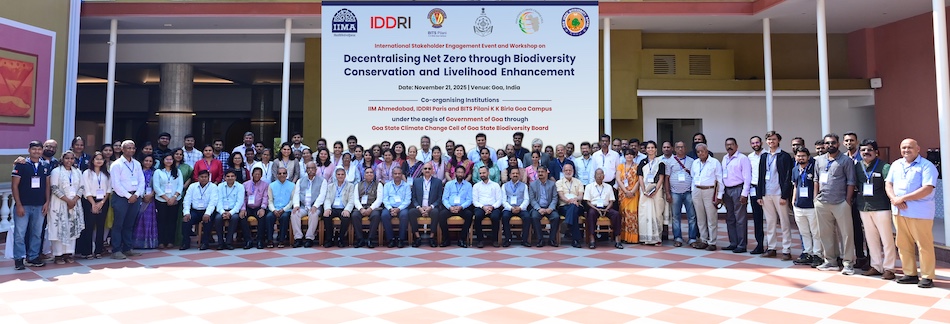
As part of another project with IDDRI (IKI-WRI – 2050 is Now), IIMA in association with IDDRI Paris, BITS Pilani K K Birla Goa Campus under the aegis of Government of Goa through Goa State Climate Change Cell (GSCCC) of Goa State Biodiversity Board (GSBB) conducted a stakeholder engagement event and workshop in Goa on November 21, 2025. This exercise was undertaken before commencing modelling and scenario development activity to help define the focused modelling efforts and scenario development in alignment with Goa’s vision and plans for climate action and energy transition.
Around 120 participants attended the event representing the Government of Goa (Goa State Biodiversity Board, Government of Goa’s Forest Department, Goa Energy Development Agency, Goa State Climate Change Cell, Goa State Council for Science and technology, Goa State Pollution Control Board, Goa Waste Management Corporation, Goa’s Department of Environment and Climate Change, Goa State Wetland Authority, Water Resources Department), Educational and Research institutions (Goa State Research Foundation, BITS Pilani K K Birla Goa Campus, Carmel College of Arts, Science and Commerce for Women Goa, ICAR-Central Coastal Agricultural Research Institute, National Centre for Polar and Ocean Research), Civil society representatives (Biodiversity committees from various villages, Act for Goa, CEE Goa, TERI Goa, Vivekananda Environment Awareness Brigade), and industry/ entrepreneurial ventures (TATA Sustainability Group, NABARD, Sunrise CSP India Private Limited, Little Himalayan Private Ltd, Eco Green Unit Foundation).
The event, titled “Decentralizing Net Zero through Biodiversity Conservation and Livelihood Enhancement,” focused on bridging the gap between global climate policies and practical grassroots implementation. Goa’s unique energy profile is the main concern, as the state imports nearly 75% of its electricity, and about 60% of its GHG emissions are contributed by its transport sector. Experts proposed various nature-based solutions, such as planting Pandanus along dunes to prevent coastal erosion while simultaneously supporting local artisanal livelihoods. Other economic opportunities identified included processing indigenous resources like wild mangoes and jackfruit to foster voluntary community conservation. Technological discussions highlighted successful waste-to-energy plants converting wet waste i.e., methane to electricity. However, implementation gaps persist; for instance, rooftop solar adoption lags due to low electricity tariffs despite state subsidies. Panelists advocated for decentralized innovations, such as portable food-processing machines and biogas units, to strengthen rural financial stability and encourage the transition to clean energy. The event concluded that community engagement and empowerment are indispensable to the net-zero mission. Ultimately, the workshop underscored that there is no one-size-fits model and highlighted the need for people-centric strategies that respect the regional socio-economic constraints and cultural contexts.