
Tuesday 11 November 2025
Localisation: Museu das Amazônias – Armazém 4A do Porto Futuro II – Av. Mal. Hermes, 14, Reduto
Title: Planejamento da Transição Energética Brasileira
11h30-12h30: Hydroelectric Power Plants and Energy Security in Brazil
. Moderation: Carolina Dubeux – COPPE/UFRJ
. Emilio La Rovere, Professor COPPE/UFRJ
. Marisete Pereira, Executive President of the Brazilian Association of Electric Power Generating Companies (ABRAGE)
Tuesday 11 November 2025 16:30 – 18:30
Title: Launch of the special COP30 edition of Parcerias Estratégicas magazine, including the article ‘Mobilizing Capital for Climate: The Role of Guarantees’ by Maria Netto, Emilio Lèbre La Rovere, Lucca Rizzo, Victoria de Castro and Jean-Charles Hourcade
Organizer: Centre for Strategic Studies and Management – CGEE
Location: Casa da Ciência, Emílio Goeldi Museum
Wednesday 12 November 2025 9:30 – 11:30
Title: Climate-Compatible Freight Transport: how to enhance international cooperation?
Location : COP30 Transport Pavilion
Organizers: UIC, KCC, IDDRI
Description:
Highlight freight’s climate impact, showcase solutions, explore policy/NDC scaling, foster international cooperation, and identify actionable themes across Avoid & Shift, Resilience, and Policy.
Speakers:
Lucie Anderton, UIC
Akshay Jamdade, SLOCAT
Stefanie Sohm, Kuehne Climate Center
Gudmundsson
GIZ/Rabea Schmecht
Ronaldo – Representante de Quilombo (ilha de Marajó – РA)
Prof. Emilio La Rovere, Professor, Energy Planning Program at COPPE/Federal University of Rio de Janeiro, Brazil
Sophie Punte, Life-Links
Anna Perez Catala, IDDRI
Marta Torres Gunfaus, IDDRI
Joo Hyan Ha (UIC and/or KCC)
Mohammed Hegazy (Climate Champions Transport Lead)
Wednesday 12 November 2025 18:30 – 20:00
Title: Transição Justa e Adaptação Climática – um diálogo empresarial global.
Location: Side Event Room 2 (Blue Zone)
Organizers: ARPEL, USCIB, IPIECA
Description: we explored the role of global business in shaping Just Transition and Climate Adaptation initiatives. With insights from both regional and global leaders, it highlights how private sector innovation can foster inclusive, market-relevant adaptation strategies that support sustainable development and just transition goals.
Key questions:
What role does the private sector play in implementing just transition initiatives?
How can adaptation serve as a tool for enabling just transition?
Just transition implementation looks different in different parts of the world – how can the private sector be a leader in ensuring responsiveness and localization?
What are some of the key takeaways for governments to consider when developing and implementing just transition and adaptation policies?
How can industrial policy best enable the private sector to accelerate implementation?
Thursday 13 November 2025, 15:30 – 17:00
Title: High-level dialogue: Turning COP energy commitments into action challenges and perspectives ahead
Location: Casa Diálogos (Tv. Campos Sales, 493 – Campina | Belém – PA
Organizers: CEBRI, Catavento
Exploring possible pathways to advance the energy commitments beyond COP30, taking into account the progress achieved so far, the main barriers and challenges experienced since the COP28, and the potential developments going forward. The discussion will focus on the commitments: (i) tripling of renewable energy capacity, (ii) doubling energy efficiency improvements, and (iii) transitioning away from fossil fuels in a just, orderly and equitable manner, providing an overall assessment and perspectives.
Thursday 13 November 2025, 18:00 – 20:00
SUSTAINABLE DEVELOPMENT: TOWARDS A COLLABORATIVE CLIMATE ECONOMY
Carbon Trading System for the BRICS: Building a Common Carbon Market
Location: Casa Sustentabilidade Brasil
Organizers: In partnership with Machado Consulting and National Association of PROMINP Graduates (ANDP)
Description: The global carbon economy is rapidly evolving and the BRICS nations have a unique opportunity to establish a cooperative framework for carbon trading that reflects their shared priorities in development, equity, and sustainability. How could a BRICS Carbon Trading System accelerate the transition towards low-carbon industries and support national net-zero commitments? What lessons can be drawn from the EU ETS and other regional carbon markets to ensure equitable participation among BRICS and BRICS+ countries? How might digital finance and blockchain technology enhance transparency, liquidity, and access for small and medium enterprises and local communities?
Moderator: Amilton Machado Costa, Director-General, Machado Consulting; President, ANDP
Speakers:
Ronaldo – Representante de Quilombo (ilha de Marajó – РA)
Prof. Emilio La Rovere, Professor, Energy Planning Program at COPPE/Federal University of Rio de Janeiro, Brazil
Max Almeida, Head Americas, Strategy and Growth, Earthood
José Aldemir, Director of Planning, Banco do Nordeste do Brasil
Marcelo Campos, Superintendent, Banco do Brasil
Evgeniy Khilinskiy, Vice President, Gazprombank; Chair of the Russian chapter of the ESG and Green Finance Taskforce of the BRICS Business Council
Friday 14 November, 16:15 – 17:15
Location: Regional Climate Foundations – RCF Pavilion, Blue Zone
Organizers:
• COPPE/UFRJ, Federal University of Rio de Janeiro
• Partner: Instituto Clima e Sociedade – iCS (Climate and Society Institute)
Title: Redirecting global savings towards climate investments in developing countries: urgency, means, and benefits
Description:
Redirecting global savings towards climate investments in developing countries is urgent to avoid a bifurcation of these countries towards development paths incompatible with the 1.5°C and 2°C temperature stabilization targets. Cooperative approaches supported by guarantee mechanisms (for example, a multi-sovereign guarantees architecture) may contribute to this redirection and deliver the short-term development and macro financial benefits in developing countries. The event will launch a debate about how to exploit this potential by launching a circle of trust between project initiators on the ground, private and public financial institutions, and governments.
Questions answered were:
- How to reframe the North-South discussion about climate finance and redirect private savings to climate-friendly investments through de-risking initiatives?
- How to obtain short-term economic and social gains for developing countries and the world economy using guarantee mechanisms?
- From theory to practical proposals: Green Guarantees Group – GGG, Multilateral Sovereign Guarantee Architecture – MSGA, Global Guarantee Facility – GCF and others.
Panelists:
Moderator: E. L. La Rovere – Professor, Head, Centro Clima/COPPE/UFRJ (Brazil), emilio@ppe.ufrj.br
Walter De Simoni – Climate Policy, Institutions and Law Manager Head, iCS (Brazil), walter.desimoni@climaesociedade.org
D. Dasgupta – Consultant, Tata Energy Research Institute – TERI (India), dipak.dasgupta@teri.res.in
Victoria Bittner – Senior Policy Officer, Federal Ministry for the Environment, Climate Action, Nature Conservation and Nuclear Safety Germany, Green Guarantees Group – GGG (Germany) Victoria.Bittner@bmwe.bund.de
Stefan Raubenheimer – Consultant, Country Platforms Hub (South Africa) and Children’s International Fund Foundation – CIFF, Stef.Raubenheimer@outlook.com
Comments:
The proposal of an multi-sovereign guarantees architecture – MSGA is backed by a Submission to the Baku to Belém Roadmap to 1.3T posted in the UNFCCC website in March 2025 by a group of scientists working on climate and development finance including within the IPCC.
The Green Guarantees Group – GGG (Germany) works to produce solution-oriented recommendations for fostering a significant increase in the use of green guarantees.
MIGA and FICs and others are building the Global Guarantee Facility (GGF) in support of the group of emerging and existing Country Platforms. The GGF is aimed at $10bn.
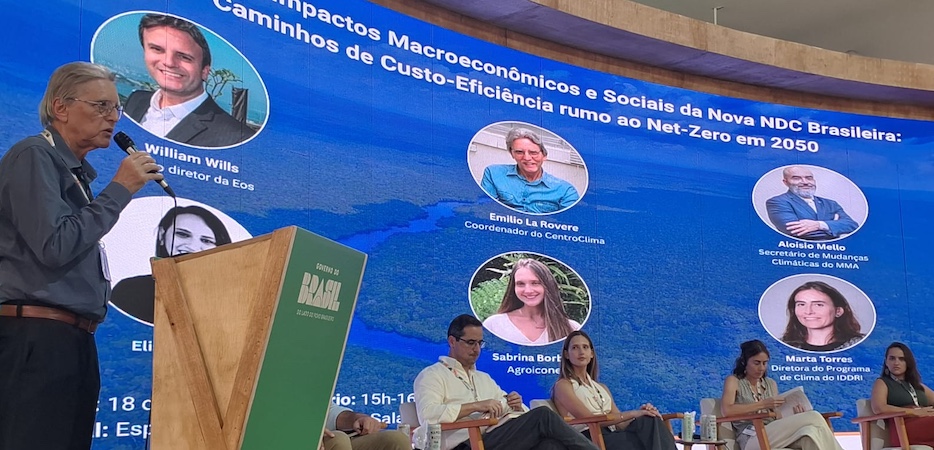
Tuesday, 18 November 2025, 15:00 – 16:00
Climate Mitigation Plan and New NDC: Assessing the Macroeconomic and Social Impacts of the NDC, towards a Just Transition in Brazil
Plano Clima Mitigação e Nova NDC: Avaliando os Impactos Macroeconômicos e Sociais da NDC, rumo a uma Transição Justa no Brasil
Description:
The event presented the results of an independent study that assesses the macroeconomic and social impacts associated with the implementation of Brazil’s new Nationally Determined Contribution (NDC), with a horizon until 2050, the year in which the country has committed to achieving net zero emissions. The study was initiated in 2024, before the finalisation of the sectoral plans of the Climate Plan, and therefore constitutes an independent assessment of the new Brazilian NDC.
The panel assessed the economic and social costs and benefits of Brazil’s transition to net-zero, exploring how different levels of climate ambition can alter the country’s growth and inclusion profile by 2050. The analysis seeked to understand the cost-effectiveness of alternative trajectories compatible with the new NDC, quantifying their effects on GDP, employment, income and sectoral distribution, as well as the impacts on industrial competitiveness and foreign trade.
Speakers:
Moderador: E. L. La Rovere – Professor Titular, Coordinator of the Climate Centre/COPPE/UFRJ
William Wills – Director of Eos and Technical Director of the Brazil Climate Centre (CBC)
Brazil office of the International Emission Trading Association (IETA)
Sabrina Borba, researcher at the Agroícone Institute
Marta Torres Gunfaus, Institut du Développement Durable et des Relations Internationales (IDDRI)
Leandro Cardoso, General Coordinator of Mitigation Policies, National Secretariat
Climate Change, MMA
Wednesday 19 November 2025 14:00 – 15:00
10th Year review of the Paris agreement; the role of science and international diplomacy to up ambition
Organiser: Institut du Développement Durable et des Relations Internationales (IDDRI)
Location: Spanish Pavilion
The event focused on the dynamics of the Paris Agreement’s ambition mechanisms, with an emphasis on the role of science and international diplomacy, including that of national scientific bodies (or equivalents) in key countries such as Brazil, India, China, as well as in France and potentially in the European Union. The idea was to create a space for exchange comparing the concrete experiences of these scientific institutions and diplomatic efforts with the ambition mechanisms and the theory of change underlying the Paris Agreement, in a context of a widely recognized lack of collective ambition.
Moderator: Marta Torres Gunfaus, Director / Climate Programme / IDDRI.
Speakers:
Marc Serra Solé, President of the Climate Action and Energy Transition, Member of the Provincial Council of Barcelona / Spain
Jean Francois Soussana, High Climate Council / France.
Elena López Gunn, Founder and Director ICATALIST / Member European Scientific Advisory Board on Climate Change, Senior Researcher Royal Elcano Institute / Spain
Vaibhav Chaturvedi, CEEW / India
Emilio Lèbre La Rovere, Professor, Centro Clima / Federal University of Rio de Janeiro / Brazil.
Thursday, 20 November 2025, 16:45 – 18:15
UFRJ – IIASA OFFICIAL UNFCCC SIDE EVENT AT COP 30
Overshoot, justice and multilateral sovereign guarantee mechanisms in climate policy and finance
Location: Side Event Room 5 (Blue Zone)
Theme:
Latest scenarios by different modelling teams show that overshooting causes irreversible impacts, limits to adaptation, and loss and damage.
Just transition policies can include a multilateral sovereign guarantee mechanism allowing for development and financial benefits in developing countries.
Panel 1: Multilateral sovereign guarantee mechanisms of climate finance
- E. La Rovere (COPPE/UFRJ, Brazil), M. Grubb (Univ. College London, UK), M. Srivastava (TERI, India), J.C. Hourcade (CIRED, France), H. C. De Coninck (Eindhoven Univ.).
Panel 2: Overshoot, just transition and adaptation
- K. Riahi (IIASA), Bill Hare (Climate Analytics), F. Denton (UNU-INRA, Ghana), A. Santos (COPPE/UFRJ, Brazil).
Subject area: Mitigation; Just transition; Loss and damage; NAPs / NDCs; Climate Finance
Additional comments