The Deep Decarbonization Pathways initiative aims at helping governments and non-state actors make choices that put economies and societies on track to reach a carbon neutral world by the second half of the century. It is an international collaboration of leading research teams who propose realistic pathways to deep decarbonization. Our work is based on a transparent common methodology to inform both science and policy.
OUR MISSION
To empower global and national decision-makers to take actions that achieve both development and climate objectives.
OUR VISION
A deeply decarbonized world with drastically reduced inequalities. We envision to be the go-to scientific network for decision-makers.
We are a global network of in-country experts who share common scientific methods, helping governments identify realistic pathways to deep decarbonization. We ground our national and international engagement on the principles of being country-driven, country-led, country-owned.
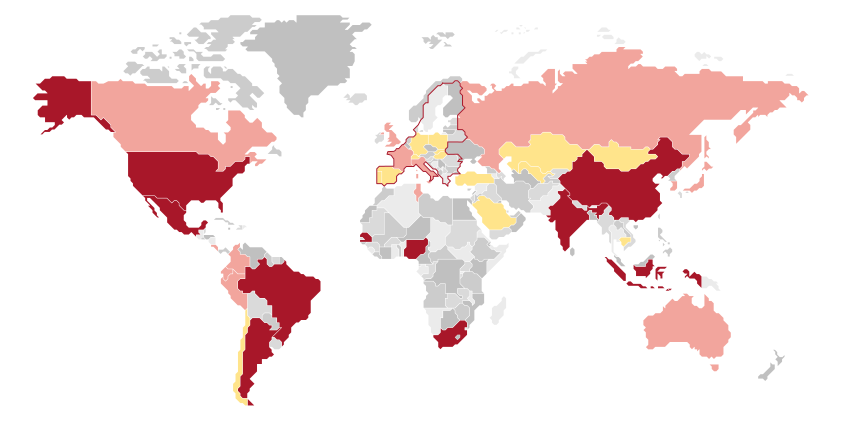
Active in-country DDP team Existing but non-active in-country DDP team Light touch engagement/emerging partnerships
Taking stock of progress by looking inside countries and sectors
This report seeks to open the box of emission pathways, by considering the multidimensional feasibility conditions-i.e. the technical, economic, political, social and institutional- that will enable the required far-reaching and systemic transformation towards the long-term goal.
Accelerating Climate Action: Navigating Towards a Low-emissions, Climate-resilient Future
Participating countries: Côte d’Ivoire, Sierra Leone, Nigeria, Senegal, Brazil, USA, India, Indonesia, European Union
Overview and objectives
1) Advancing just and effective climate strategies
ACCLIMATE supports the global transition to low-emission, climate-resilient development through the co-creation of science-based and inclusive strategies. Aligned with the Paris Agreement and the Sustainable Development Goals, the project brings together researchers, policy experts, and national stakeholders to design integrated pathways that are technically robust, socially just, and politically feasible.
2) Responding to real-world challenges Climate pledges often fall short in ambition, clarity, and feasibility. Many countries face structural barriers, limited technical capacity, and complex trade-offs between development and decarbonization. In addition, climate governance frequently overlooks gender, equity, and the lived realities of vulnerable communities. ACCLIMATE addresses these gaps by integrating robust modeling, stakeholder co-creation, and equity-driven analysis across the project.
3) Embedding gender and equity ACCLIMATE recognizes that inclusive climate action requires more than data and models—it demands attention to social justice and representation. The project mainstreams gender and intersectional equity throughout its research, engagement processes, and policy design, ensuring that strategies are shaped by diverse voices and responsive to different needs.
4) A dual approach: co-creation and analysis ACCLIMATE combines policy engagement with rigorous research. National stakeholder dialogues and international Sectoral Conversations ensure relevance and ownership, while scientific modelling supports the development of fair and ambitious national, sectoral, and global pathways.
5) A global collaboration Funded by the EU Horizon Europe programme, ACCLIMATE runs from March 2025 to February 2029 and involves 20 partners from Europe, Africa, Asia, and the Americas. Together, they work to strengthen national strategies, enhance modelling capacity, and support more coherent and effective international climate governance.
Partner organizations:
Brazil: COPPETEC/UFRJ (Fundacao Coordenaçao de Projectors, Pesquisas e Estudios Tecnologicos/ Universidade Federal do Rio de Janeiro)
India: Council on Energy, Environment and Water Trust (CEEW)
Indonesia: CCROM Centre for Climate Risk and Opportunity Management in Southeast Asia Pasific (CCROM ) | CREP-ITB: Center for Research on Energy Policy (CREP) is one of research centers of Institut Teknologi Bandung
Nigeria: University of Port Harcourt (UNIPORT)
Sierra Leone: University of Sierra Leone (USL)
Senegal: ENDA Energie Environnement Developpement South Africa : University of Cape Town
USA: University of Maryland Foundation (USMF)
The ACCLIMATE project has received funding from the European Union’s Horizon Europe Innovation Action programme under Grant Agreement No. 101184374.
———————————————————————————————————-
The content of this page is for information purposes only. Neither the European Commission nor CINEA accept responsibility for any use made of the information contained herein.
The ACCLIMATE project is an European Union’s Horizon Europe Innovation Action programme’s funded project, which focuses on supporting the global transition to low-emission, climate-resilient development through the co-creation of science-based and inclusive strategies.